
Learning Underwater Robotics in Hsinchu
Five AAV members visited NYCU’s ORCA AUV lab and the Taiwan Space Agency, bringing back lessons for the team’s first underwater vehicle and its three-domain RobotX 2026 fleet.
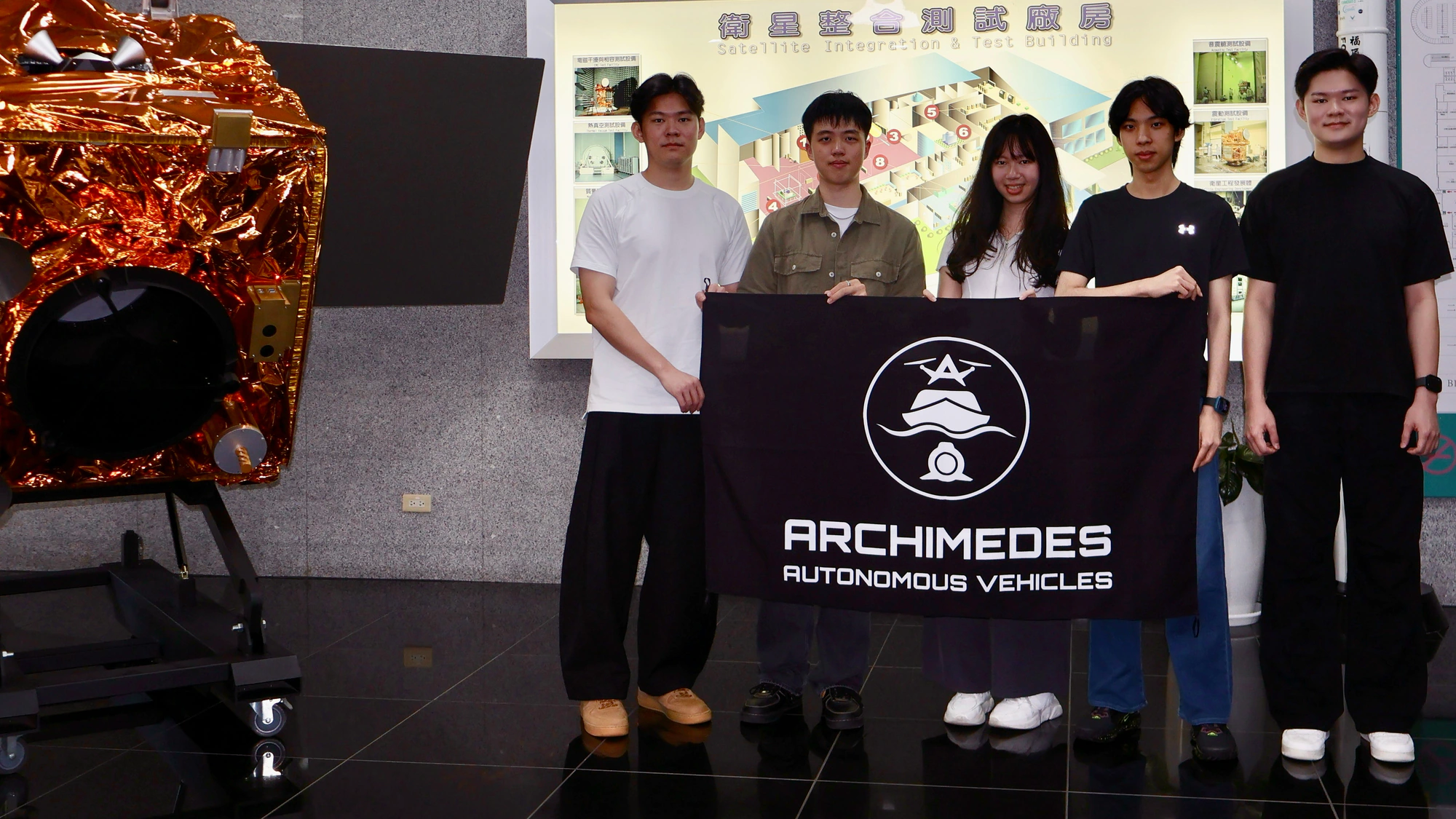
On 21 July, five AAV members travelled to Hsinchu to learn from the ORCA AUV Underwater Robotics Lab at National Yang Ming Chiao Tung University (NYCU). With RobotX 2026 taking AAV underwater for the first time, the visit followed months of correspondence about the challenges ahead.
The discussion at NYCU centred on navigation without the GPS and radio links familiar from aerial and surface vehicles. The teams explored localisation, Doppler velocity logs, sonar and waterproofing, then compared approaches to sponsorship, documentation and passing knowledge to the next generation of members. AAV brought NTU pens and MAE caps, and returned with ORCA team shirts and practical advice for the new build.
Earlier that day, the team visited the Taiwan Space Agency (TASA). Its vibration, vacuum and thermal testing facilities showed how satellite subsystems are checked against launch and orbital conditions. Mission control offered another perspective on integration, with routine communications and health monitoring largely automated between major operations.
An informal dinner with TSMC engineers extended the day’s conversations to the infrastructure behind semiconductor manufacturing: cooling, power, water, gases and shift operations. A drive through Hsinchu Science Park put the scale of those supporting systems into perspective.
Three newer AAV members helped drive the technical exchange: Simulation Lead Nathan Lee, mechanical member Yi-Heng Chen and electrical member Hsin Yun Han. Their questions connected sensing, localisation and waterproofing across disciplines, reflecting the coordination needed to bring AAV’s aerial, surface and underwater vehicles together.
Thank you to ORCA AUV, NYCU, TASA and the engineers who shared their time and experience. The visit gave AAV a clearer view of the engineering work behind a reliable fleet, from individual components to the systems that connect them.
In pictures
Organisations involved
- ORCA AUV Underwater Robotics Lab
- National Yang Ming Chiao Tung University
- Taiwan Space Agency